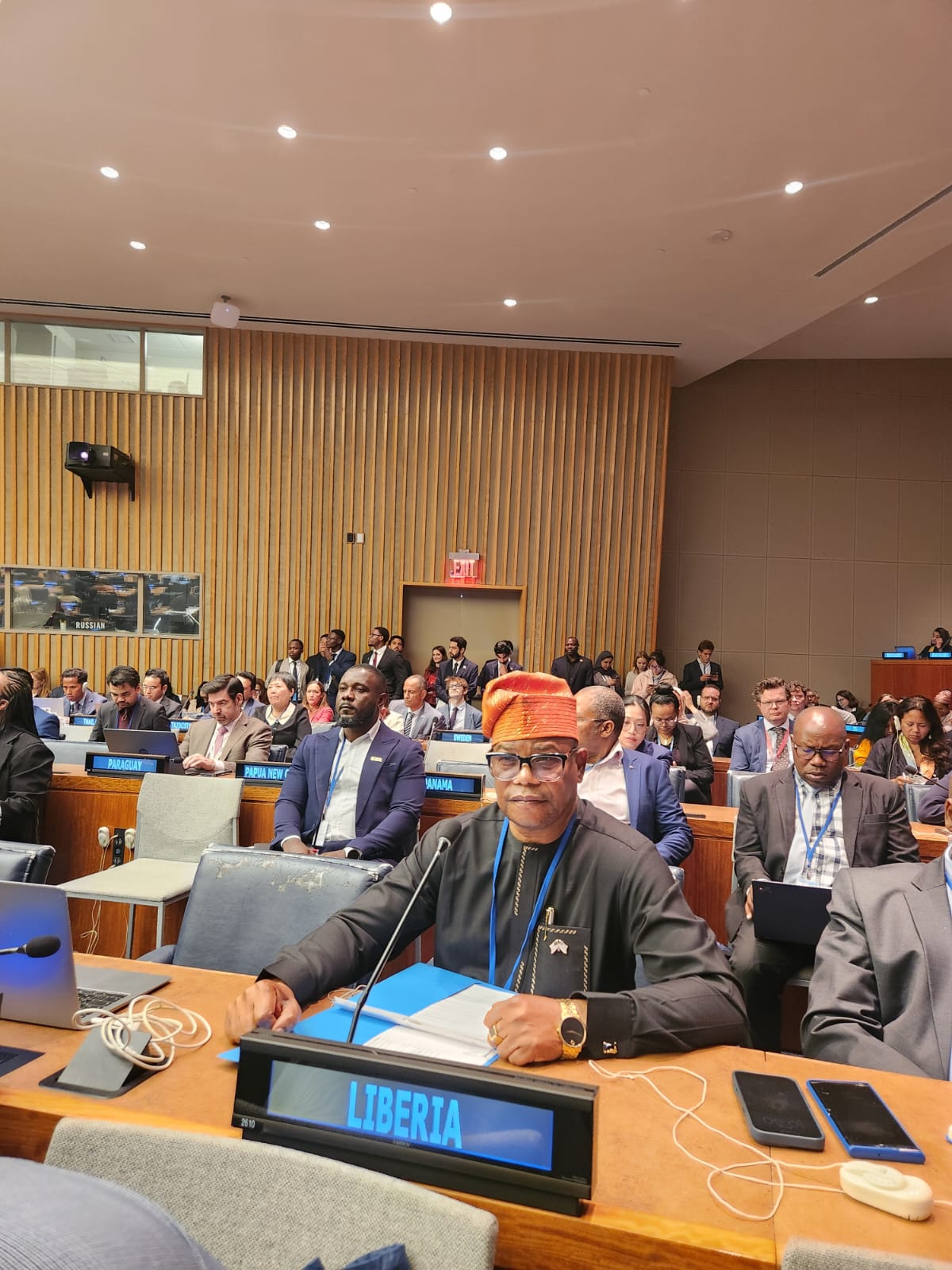
New York, United States | July 13, 2026 – The Minister of Mines and Energy of the Republic of Liberia, Hon. R. Matenokay Tingban, has reaffirmed Liberia's unwavering commitment to achieving universal access to affordable, reliable and sustainable energy, while calling for stronger international partnerships and increased investment to accelerate the country's energy transition and advance sustainable development in line with the Government's ARREST Agenda for Inclusive Development (AAID).
Delivering Liberia's Third Voluntary National Review (VNR) at the United Nations High-Level Political Forum (HLPF) on Sustainable Development at the United Nations Headquarters in New York, the United States of America, Minister Tingban highlighted Liberia's significant progress toward the implementation of the Sustainable Development Goals (SDGs), with particular emphasis on SDG 7 – Affordable and Clean Energy. The Minister's statement formed part of the Forum's in-depth review of SDGs 6, 7, 9, 11 and 17 under the 2026 HLPF theme: "Transformative, equitable, innovative and coordinated actions for the 2030 Agenda for Sustainable Development and its Sustainable Development Goals for a sustainable future for all."
Minister Tingban reaffirmed that Liberia's progress is being driven by the Government's ARREST Agenda for Inclusive Development (2025–2029), which aligns approximately 83 percent of its priority interventions with the Sustainable Development Goals. He emphasized that affordable and sustainable energy remains a cornerstone of the Government's development agenda, serving as a catalyst for economic transformation, industrialization, improved healthcare and education, private sector growth, job creation and inclusive national development.
Highlighting Liberia's growing momentum in the energy sector, Minister Tingban announced that national electricity access has increased from 32.7 percent in 2024 to 38 percent in 2026, supported by an installed generation capacity of 146 megawatts (MW) derived primarily from renewable energy sources, including hydropower and solar. The progress reflects sustained Government investment in renewable energy infrastructure, rural electrification and strategic partnerships that are expanding access to reliable and affordable electricity across the country.
The Minister further disclosed that Liberia has already achieved nearly 80 percent of its first-year electricity connection target under the Mission 300 Energy Compact, bringing electricity to hundreds of thousands of Liberians who previously lacked reliable access to power. The Government's ambitious target is to increase national electricity access to 75 percent by 2030, significantly expanding opportunities for households, businesses and public institutions.
"Access to modern energy is not merely about electricity; it is the foundation upon which education, healthcare, economic opportunity, industrial growth and improved livelihoods are built," Minister Tingban stated.
He noted that expanding access to affordable and reliable energy remains central to the Government's efforts to improve livelihoods, strengthen healthcare and education systems, support businesses, stimulate economic growth and create opportunities for rural and underserved communities. He further emphasized that clean energy development is a key pillar of Liberia's climate resilience strategy and long-term sustainable development ambitions.
While recognizing Liberia's remarkable progress, Minister Tingban acknowledged that significant challenges remain. In addition to the country's dependence on seasonal hydropower, which contributes to an estimated 72-megawatt generation shortfall during the dry season, he cited the growing impacts of climate change, volatility in global energy markets, declining official development assistance and increasing fiscal pressures as major constraints to achieving universal energy access. He stressed that these realities underscore the urgency of diversifying Liberia's renewable energy mix, strengthening electricity infrastructure and building a more resilient and sustainable energy system.
To address these challenges, the Minister outlined Liberia's comprehensive energy transition strategy, which prioritizes large-scale solar power generation integrated with battery energy storage systems, expansion of the Mount Coffee Hydropower Plant, strengthened regional electricity trade through the West African Power Pool, and accelerated deployment of renewable mini-grids and standalone solar systems to expand electricity access in underserved and remote communities.
He further announced that Liberia has identified more than 1,000 megawatts of additional renewable energy potential through hydropower and solar development, presenting significant opportunities for private sector participation, foreign direct investment and strategic international partnerships that will support long-term energy security and sustainable economic growth.
Recognizing that achieving SDG 7 extends beyond electricity access alone, Minister Tingban also announced Liberia's commitment to launching its first National Clean Cooking Strategy, which seeks to provide clean cooking solutions to 200,000 households by 2030. The initiative aims to reduce indoor air pollution, improve public health, protect forests and promote environmental sustainability, particularly for women and children who remain disproportionately affected by traditional cooking practices.
The Minister emphasized that achieving universal access to affordable, reliable, sustainable and modern energy will require stronger international collaboration. He noted that implementing Liberia's Mission 300 Energy Compact requires an estimated investment of US$1.5 billion, leaving a financing gap of approximately US$1.25 billion. He therefore called on development partners, multilateral financial institutions, climate funds and the private sector to expand support through concessional financing, blended finance, technology transfer, technical assistance and innovative investment mechanisms that will accelerate Liberia's clean energy transition.
Throughout the High-Level Political Forum, Heads of State and Government representatives, United Nations agencies, international financial institutions, development partners, civil society organizations and private sector leaders underscored the urgent need to accelerate implementation of the Sustainable Development Goals through innovative financing, resilient infrastructure, expanded clean energy investment, technology transfer and stronger global partnerships. Participants emphasized that, with only four years remaining before the 2030 deadline, coordinated international action is essential to close persistent development gaps and ensure that no country is left behind.
Reaffirming Liberia's commitment to collaborative action, Minister Tingban emphasized that the Government stands ready to work closely with bilateral and multilateral partners to mobilize the investment, technology and expertise needed to transform Liberia's energy sector, strengthen energy security and deliver inclusive and sustainable national development for all Liberians.
Closing his address with a strong call for global solidarity, Minister Tingban declared:
"Every megawatt we add brings another Liberian community out of darkness. Liberia is reaching for the light, and we invite the international community to partner with us in building a more prosperous, resilient and sustainable future for all Liberians."
MINISTRY OF MINES AND ENERGY-LIBERIA PUBLIC RELATIONS
For additional informational about the Ministry, visit our Facebook page:
https://www.facebook.com/profile.php?id=61573832151952
PR Unit Contact: +231770902967