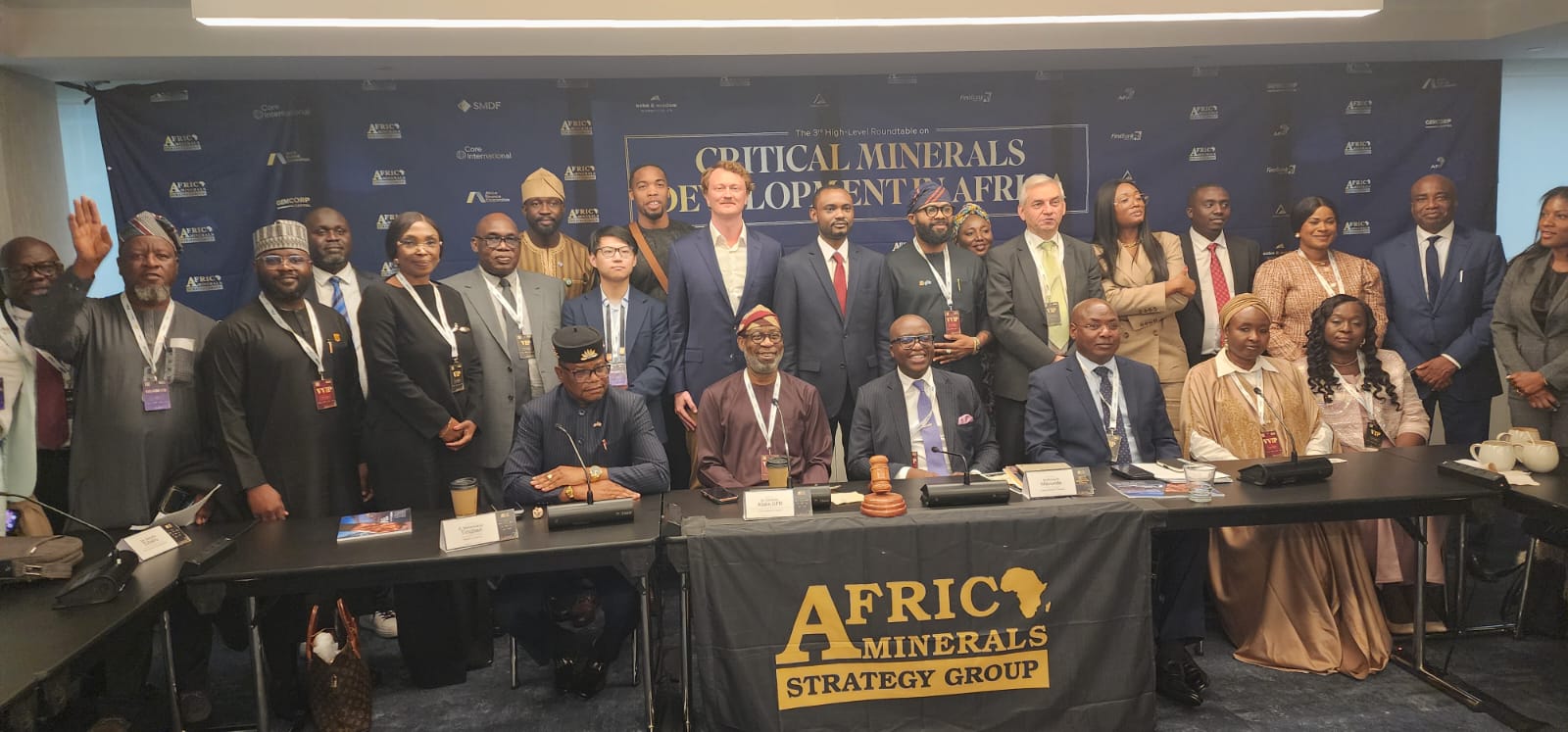
New York, United States of America: 21 September, 2026: The Africa Minerals Strategy Group (AMSG) reaffirmed its commitment to collaborating with African countries to exit from the export of raw minerals toward greater value addition, industrial development, and stronger participation in global critical mineral supply chains.
This commitment was made at a high-level meeting that brought together African Ministers, regional government representatives, development financial institutions, investors, industry leaders, technology experts, and strategic partners.
As he continues his push for an improved mining and energy sectors for his native Liberia, the Country was represented at that high-level meeting in New York by the Minister of Mines and Energy, Honorable R. Matenokay Tingban.
The Minister participated made an excellent impression on that high-level meeting as part of his representation and Liberia's contribution to the discussions was well presented by him. He expounded on advancing Africa’s mineral value chains and strengthening the continent’s role in the global critical minerals sector. This event was the 'Third High-Level Roundtable on Critical Minerals Development in Africa'.
It was held on September 2 l, 2026 in New York, on the margins of the 81st Session of the United Nations General Assembly. The Roundtable provided a platform for African leaders and strategic partners to discuss practical approaches to strengthening Africa’s position in the global critical minerals’ economy. Under the theme, “From Resources to Wealth: Continental Cooperation for Mineral Value Addition, Data Sovereignty, Innovative Financing and Critical Minerals Security,” the meeting focused on mineral value addition, geological data generation and exploration, innovative financing, infrastructure development, and critical minerals security.
Liberia Highlights Critical Minerals and Strategic Partnerships.
Honorable R. Matenokay Tingban, Minister of Mines and Energy, presented Liberia’s approach to advancing its mineral sector beyond the export of raw materials. He highlighted established resources, including iron ore, gold, and diamonds, alongside emerging prospects in lithium, cobalt, manganese, rare earth elements, nickel, niobium, and uranium.
He noted that unlocking this potential requires reliable geological information, expanded exploration, modern technology, processing capacity, energy, infrastructure, and market access. The Minister stressed the need to graduate from policy discussions to practical projects that deliver measurable results.
He informed potential investors that Liberia is seeking strategic partners—not only buyers of minerals, but investors interested in exploration, project development, processing, infrastructure, renewable energy, technology transfer, and skills development. He also emphasized responsible mining through environmental protection, land reclamation, community participation, occupational health and safety, transparent licensing, and regulatory compliance.
Minister Tingban further underscored the importance of cooperation in geological data, exploration, power, research, trade, and investment. He noted that critical minerals can support industrialization, quality employment, local enterprise growth, and long-term economic advancement. He also highlighted regional mineral corridors as a means of linking producing countries with processing facilities, ports, and markets, strengthening cross-border value chains and expanding economic opportunities.
Present at the high-level meeting also were other African Leaders. Among them and in contributing to the discussions, Senator Kashim Shettima, Vice President of the Federal Republic of Nigeria, representing President Bola Ahmed Tinubu, called for stronger African cooperation and greater local processing of mineral resources. He emphasized that the value of Africa’s minerals should be measured not only by export revenues but also by the creation of jobs, industries, infrastructure, technology, and broader economic opportunities they generate.
Also in speech, Honorable Dele Alake, Minister of Solid Minerals Development of Nigeria and Chairman of the AMSG Ministerial Steering Committee, called for stronger measures to formalize the artisanal and small-scale mining sector, and improve safety in the sector. He proposed establishing an African safety facility for artisanal mining, as well as a Mine Emergency and Community Recovery Fund to strengthen emergency response and support affected mining communities.
For his part, the Minister of Kenya emphasized the importance of geological and mineral data sharing, domestic resource mobilization, and regional cooperation. He also called for greater coordination of licensing and investment processes while respecting national sovereignty, while the Tanzanian Minister stressed the need to move beyond raw material production toward beneficiation, processing, refining, and manufacturing. He emphasized that African countries should develop complementary regional value chains based on their respective strengths.
The Minister of Chad highlighted the importance of geological mapping, airborne surveys, remote sensing, and digital geological information to the development of the mineral sector. He also encouraged modern licensing systems, infrastructure development, and regional mineral corridors, particularly to support landlocked countries.
At that high-level meeting, the Africa Finance Corporation (AFC) emphasized that mineral development requires regional approaches that combine financing, infrastructure, processing, logistics, and market access, with a focus on practical and commercially viable projects. The International Trade Centre (ITC) stressed the need for coordinated policies, stronger trade and investment links, and regional value chains, with the African Continental Free Trade Area (AfCFTA) providing an important platform for integration and investment.
The European Union emphasized mobilizing private investment across exploration, mining, processing, refining, and recycling, alongside infrastructure, skills development, geoscience cooperation, and responsible environmental and social practices. The discussions resulted in a commitment to strengthen geological information, mobilize capital, develop regional infrastructure, promote value addition, facilitate technology transfer, and enable African countries to retain greater economic value from their mineral resources.
The session focused on financing, local ownership, project selection, and technology as key challenges in Africa’s mineral sector. The discussions emphasized improving access to capital and local participation, applying merit-based project assessment, and using AI, automation, and digital systems to strengthen exploration, regulation, monitoring, and efforts to combat illegal mining.
Continental Declaration Signed
The Roundtable concluded with the signing of the Continental Integration and Economic Assurance Declaration, marking a shift from policy dialogue toward implementation. Nigeria signed the Declaration, while participating Ministers committed to completing the process. The Declaration promotes coordinated policies, predictable investment conditions, regional mineral corridors, shared infrastructure, mineral processing, and responsible investment, with the AMSG providing a mechanism to monitor commitments and advance practical projects.
AMSG Leadership Calls for Action
In his closing remarks, Hon. Dele Alake, Minister of Solid Minerals Development of Nigeria and Chairman of the AMSG Ministerial Steering Committee, called for the AMSG to move from policy discussions to practical implementation, investment, and measurable results, supported by stronger cooperation among governments, the private sector, financial institutions, and strategic partners.
The Secretary-General of the AMSG stated that the membership has doubled from 16 to 32 countries since January 2024, with four priorities: mineral value addition, exploration and geological data, innovative financing, and Africa’s position in global critical mineral supply chains. He also highlighted the Group’s Mutual and Assured Development Framework and efforts to formalize artisanal and small-scale mining and strengthen safety.
For Liberia, the Roundtable creates opportunities to attract investment in exploration and mining, improve geological data, expand local processing and value addition, access technology and financing, and develop supporting infrastructures. These efforts can generate jobs, strengthen local businesses, increase government revenues, and retain more value within Liberia’s economy. The priority is now to convert these opportunities into bankable projects, strategic partnerships, and measurable economic outcomes for Liberia.
MINISTRY OF MINES AND ENERGY-LIBERIA PUBLIC RELATIONS
For additional informational about the Ministry, visit our Facebook page:
https://www.facebook.com/profile.php?id=61573832151952
PR Unit Contact: +231770902967